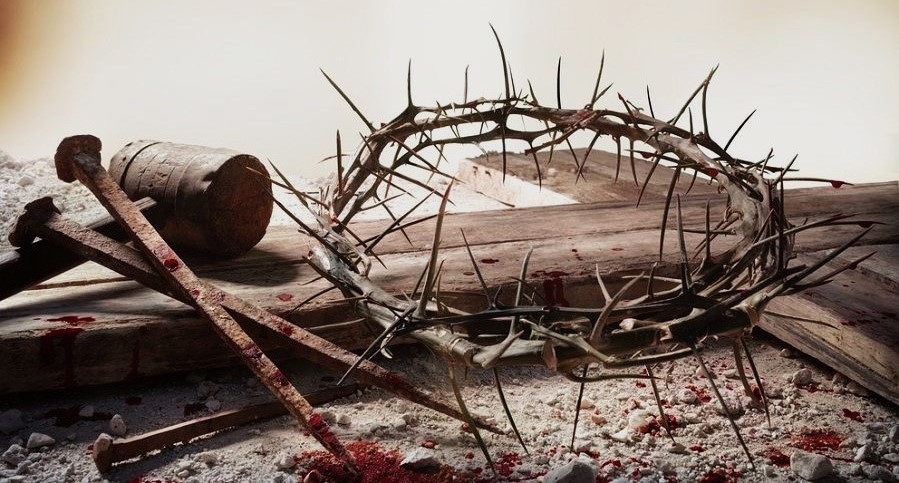
HIS AGONY, OUR REDEMPTION
(Written Assignment 6 – Write a 2,000-word essay on a topic of your choice)
Isaiah 53:5 (ESV)
“But He was pierced for our transgressions; He was crushed for our iniquities; upon Him was the chastisement that brought us peace, and with His wounds we are healed“
Much has been said about the redemptive work of Jesus Christ on the cross. John 3:16 tells us that for God so loved the world that He gave His only Son, that whoever believes in Him shall not perish but have eternal life. Redemption does not come free. Without the shedding of blood, there is no forgiveness of sins (Hebrews 9:22). The inestimable price of Jesus’ incorruptible blood is the only way to set us free. Christ is qualified to pay the penalty for our sin because He is without sin (2 Corinthians 5:21).
Jesus chose to endure the suffering, scorn and shame when He willingly accepted the cup of God’s wrath at the Garden of Gethsemane; the beginning of the physical trauma of the Son of God fulfilling His destiny as the Saviour. Luke 22:44 describes the agony and great emotional stress that Jesus faced – in anguish, He prayed earnestly till His perspiration was like great drops of blood and God had to send an angel to minister to Him. Although He was with His disciples, yet He was alone throughout the whole ordeal for they fell asleep and failed to give him the emotional and prayer support He needed.
The first Adam lost his victory in a garden and the second Adam won His there. Jesus, the sinless one, traded place with us. He took on the face of a sinner in order that we sinners could take on the face of a saint! He chose to die in the most painful way. Crucifixion is a slow excruciating death, designed to produce maximum suffering and pain. His death created doubts and raised questions. People often ask what held Jesus onto the cross when He could appeal to His Father and He will at once send more than twelve legions of angels to His aid (Matthew 26:53). So what kept Jesus at the cross?
He was tormented, struck in the face and head. His beard was pulled out and his face spit upon by the wicked people (Isaiah 50:6). He was also stripped, flogged, mocked and tortured. By the time the Sanhedrin and the Roman soldiers were done with Jesus, He was soaked in blood and swollen all over, gashed beyond recognition. He was battered, bruised, dehydrated and exhausted. Brutally beaten and scourged mercilessly, His appearance was disfigured beyond that of any human being and His form marred beyond human likeness (Isaiah 52:14). The people who knew Him were appalled at His horrific appearance.
The following medical explanation (a summarised version) written by Dr C Truman Davis (1965) illustrates the agony of what Jesus endured on the day He died.
“As for the flogging, it was aimed to weaken the victim to a state just before death. The whip consisted of a number of heavy leather thongs with two small balls of lead attached near the ends of each. The heavy whip was brought down with full force repeatedly on the exposed shoulders, back and legs until the entire back turned into an unrecognizable mass of torn and bleeding tissue. When the beating finally stopped, the half-fainting Jesus was left to collapse onto His own blood. The Roman soldiers then threw a robe across His lacerated body, pressed a ‘crown’ of long thorns into His scalp and placed a stick in His hand for a sceptre, taunting Him as King of the Jews (Matthew 27:29). As the scalp is one of the most vascular parts of the body, Jesus bled profusely again. The soldiers drove the thorns even deeper by striking Him across the head. And when they finally got tired of their sadistic game, the robe was torn from his back, causing piercing pain as the robe had already adhered to the scourging wounds.
The wooden beam across Jesus’ shoulders (John 19:17) was too much for Him to carry due to the copious blood loss and weakened condition. His strength was pushed beyond endurance. Hence, he collapsed and in the process, the beam gouged further into the mutilated skin and torn muscles of His shoulders. Simon from Cyrene was conscripted to carry the cross. Upon reaching Golgotha, the dreadful crucifixion began (John 19:18). Heavy iron nails were ruthlessly driven through both wrists and the feet of Jesus, sending bolts of fiery pain into His body.
As Jesus slowly slumped on the cross, the nails in the wrists bearing His weight would put pressure on the median nerves, thus generating a searing pain along the fingers up to the arms to explode in the brain. And when He tried to push Himself upward to avoid this stretching torment, His full weight would have rested on the nail through His feet. Such a shift caused the nail to tear through the nerves between the metatarsal bones and triggered intense pain. Air could be drawn into the lungs, but could not be exhaled. Jesus had to struggle to raise Himself in order to get even one short breath. Eventually, carbon dioxide would build up in the lungs and in the blood stream. Since speech occurs during exhalation, the brief utterances of Jesus from the cross must have been particularly difficult and painful.
Jesus endured hours of massive pain with spasmodic partial suffocation. In time, the heart struggled to pump and the tortured lungs made frantic effort to gasp small gulps of air. This description fulfils what the psalmist said about the agony of Jesus – “I am poured out like water, and all my bones are out of joint. my heart is like wax; it is melted within my breast” (Psalm 22:14). The body of Jesus was at the point of death. Finally, He could allow His body to die. With one last surge of strength, He pressed His torn feet against the nails once again, straightened His legs, took a deeper breath, uttered His last cry and breathed His last (Luke 23:46).”
Besides the physical pain, Jesus had to deal with the horror of having to bear all the consequences of the sin of humanity on Himself (Isaiah 53:12) and to be rejected by His Father. The Father and Son had never been separated and the prospect was terrifying. Far worse than the breaking of His body, it was the shredding of His heart when His own Father turned His back on Him (Matthew 27:46). While Jesus waited for death, He also suffered emotionally and mentally as He watched Mary, John and the others grieving for Him. So what held Jesus to the cross? What kept Him there? The nails? No, it wasn’t the nails that held Him there but the obedience to do His Father’s will and His great love for us. God shows His love for us in that while we were still sinners, Christ died for us (Romans 5:8).
Within those six hours one Friday, Jesus was cursed on our behalf. He suffered the ultimate shame, humiliation and disgrace of being hung on a ‘tree’ (Acts 5:30). And upon that cross, God embedded in the earth three anchor points for us – lives are not futile, failures are not fatal and death is not final. The blood of the Lamb comes forth and cleanses, inviting those who are weary and burdened to come to Him and He will give us rest (Matthew 11:28).
The gift of the cross required only the shedding of blood for our salvation but Jesus did much more for us. Let us examine some of the other ‘gifts’ surrounding the crucifixion of Christ and the significance of the promises they offer. These ‘gifts’, ranging from the soldiers’ spit to the empty tomb, teach us about the nature of God. It also speaks of each symbol as a ‘gift of grace’ that reveals God’s love for mankind. If you then, who are evil, know how to give good gifts to your children, how much more will your Father who is in heaven give good things to those who ask him! (Matthew 7:11). As we unwrap some of these gifts of grace, perhaps we may hear His still small voice telling us that He did it just for us.
God’s promise in the soldiers’ spit – The spit on Jesus’ face (Matthew 26:67) was intended to degrade Him. The ‘beast’ that was evident in the soldiers is also within each of us. Perhaps we have never spit on anyone, but what about gossiping? Or rolling our eyes in arrogance? The soldiers’ spit, mingled with blood and sweat, was caked onto Jesus’ face as He carried it to the cross. It symbolizes the filth in our hearts. Jesus becomes the beast so that the beast can become the beauty.
God’s promise in the nails – Each of us has a list of weaknesses and the price of those sins was death. That was why Jesus did not stop the soldiers from nailing His flesh onto the rugged beam. It is the only way He could nullify the charges against us – by nailing them to the cross covered in His blood (Colossians 2:14). And as the hands of Jesus opened for the nails, the doors of heaven opened for us.
God’s promise in the sign – Among the many signs that God gave us, one of the most important signs was written on the cross. Pilate wrote “Jesus of Nazareth, the King of the Jews” (John 19:19). This would have impacted one of the criminals beside Jesus who pleaded to be remembered (Luke 23:42). It is most likely that the response was because he read the sign. Pilate meant his inscription as a savage taunt to the Jews but God had another purpose. As such, there is no person that God will not use. And since it was written in three languages – Aramaic, Latin and Greek (John 19:20), it signifies that God will speak to us in our language.
God’s promise through the torn flesh – Hebrews 10:20 states that a new living way has opened for us through the curtain, that is, His body. The writer referred the curtain to the body of Jesus. Hence, whatever happened to Jesus’ flesh happened to the curtain. His flesh was torn by the whips and thorns, by the point of the nails and the weight of the cross. But in the horror of His torn flesh, we find the splendour of the open door, in which Jesus invites us into His presence.
God’s promise in the wine-soaked sponge – Before the nail was pounded, a drink was offered to Jesus. It was wine mixed with myrrh/gall, a sedative that numbs the senses. In refusing the drink and opted instead to feel the full force of His suffering, Jesus is able to understand our pain. He knew we would undergo sufferings in life and He will respond generously to all without finding fault with us (James 1:5).
God’s promise in the blood and water – The blood represents God’s work for us and in us. The former refers to the positional sanctification – the state of holiness imputed to Christians at the moment of their conversion (1 Corinthians 1:2) while the latter refers to progressive sanctification – the process of being Christ-like in our daily lives (Colossians 3:1-10). We are being saved and being transformed. The spring of water will gush up inside us, giving eternal life (John 4:14).
God’s promise in the burial clothing – The garments seemed like a tragedy at the time of Jesus’ death but by Easter morning, they symbolized the clothing of life. When John saw the burial clothes still wrapped in their original position (John 20:7), he saw the power of life. God can turn tragedy to triumph for those who love Him.
It is very natural to feel sorry for the crucified Jesus and pity Him for the brutal suffering but we must resist the temptation to do so, bearing in mind that Jesus did not die as a helpless victim. John 10:18 states that no one takes His life from Him, but He would lay it down of His own free will as He has the authority to lay it down and to take it back again. The Cross of Christ is a victory for the Son of Man. Because of what Jesus did, we are now able to live victoriously and enter into the very presence of God.
Reference:
The Bible
He chose the nails by Max Lucado
Six hours one Friday by Max Lucado
AIM notes on “Life of Christ”
“The Crucifixion of Jesus Christ” by C. Truman Davis, M.S. March, 1965
Date written: 15 December 2015
 Dolly's Sharing